When you’re researching quartz worktop prices, you’ll come across a huge range of quotes, and it can be hard to know what’s reasonable and what’s too good to be true. So, how much does a quartz worktop cost in the UK, and why do quotes differ so much?
In this guide, we break down the true cost of quartz worktop installations in the UK, what drives pricing, how pricing metrics work and three realistic examples to help you budget accurately.
What drives quartz worktop prices in the UK?
Whether you’re looking at quartz worktop prices per metre or full project quotes, the final figure depends on far more than just raw material costs. Understanding the other variables helps you compare quotes accurately and make an informed decision.
Quality, provenance, and brand trust
Before looking at aesthetic design, it is vital to understand that not all engineered stone is created equal. Cheaper stones that look "too good to be true" may be the result of poor manufacturing processes, a lack of critical safety documentation, or unproven performance.
Crucially, brand reputation and material source play a major role in long-term value and safety. Choosing a premium brand like Caesarstone guarantees you’ll receive certified, fully documented material quality and the total peace of mind of a lifetime warranty. Caesarstone offers options across multiple price groups, starting with our Essentials collection. At the Essentials level, Caesarstone is positively comparable in price to unbranded materials that often come with questionable origin, a complete lack of documentation, and unclear or non-existent warranties. While there is a slight premium for choosing Caesarstone at upper price bands, it is not a massive one, and the long-term value, design authority, and post-purchase security far outweigh the risks of unbranded stone. If you are seeing significant variations across quotes you've received, speak to us or get a direct quote beforehand to ensure you are comparing like-for-like quality.
Colour and collection
Design, pattern depth, and manufacturing complexity all directly affect material price tiers. Entry-level, classic designs fall into lower, essential price bands, while intricate veining, textured finishes, or heavily detailed aesthetics sit within premium collections.
Thickness: 20mm vs 30mm
Standard engineered surfaces generally come in 20mm and 30mm thicknesses. A 30mm slab requires more raw material and incurs higher transportation costs, typically adding 15% to 25% to the material cost compared to 20mm. While 20mm remains a sleek, modern favourite for contemporary handleless designs with clean pencil edges, there is a growing return to more ornate, decorative edge profiles, particularly in high-end, bespoke kitchen design.
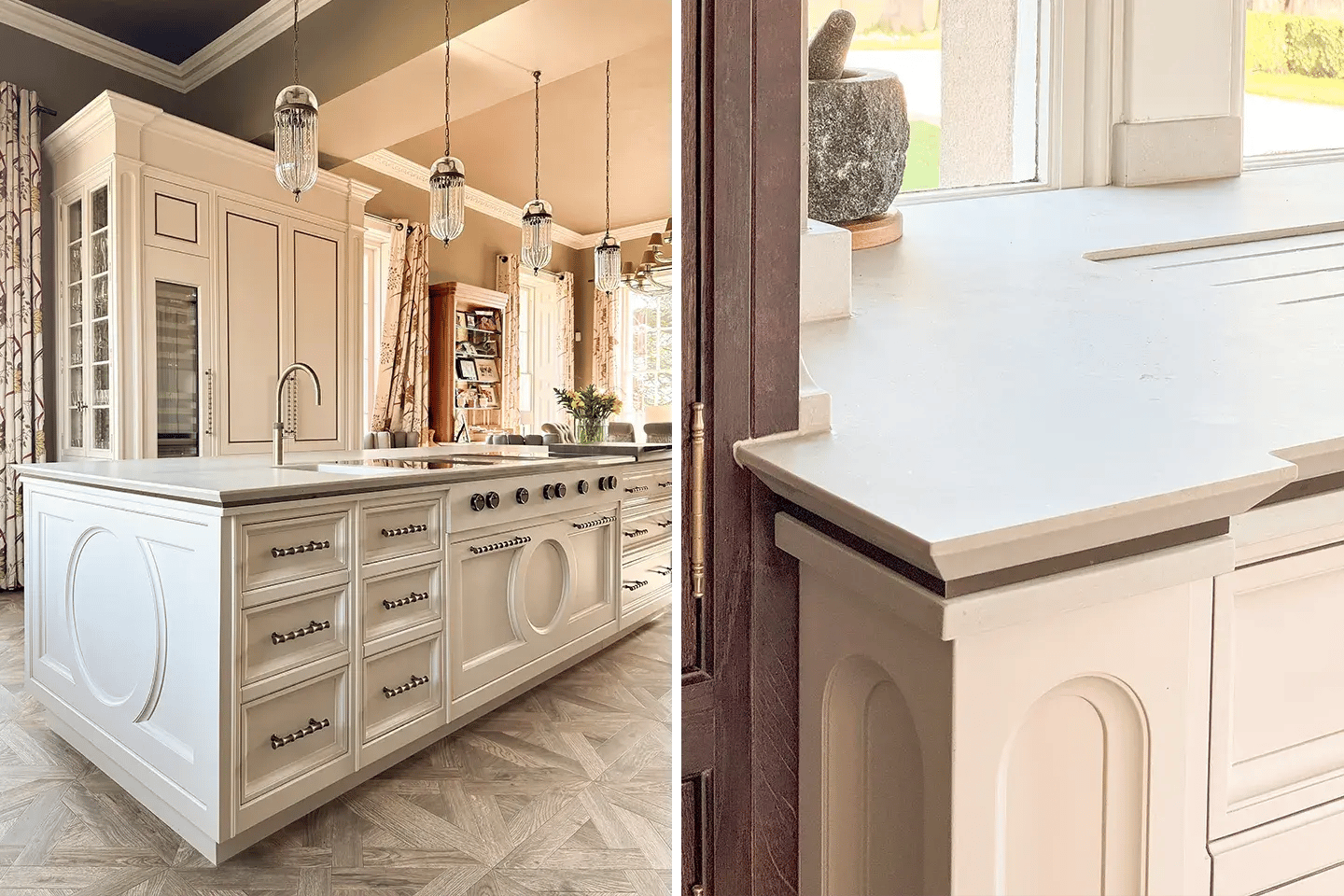 Case Study: A calm, timeless kitchen in a heritage home (Photography by Martin Holliday)
Bespoke kitchen designers are increasingly pulling back from ultra-streamlined, minimalistic 20mm edges in favour of classic, tactile profiles (such as ogee or deep bullnose). Achieving these detailed or built-up decorative edge profiles typically requires a 30mm thickness or even deeper mitred, built-up edges to deliver the desired architectural impact, which adds both material depth and skilled CNC/hand-finishing labour.
Learn more about worktop edge profiles in our guide.
Cutouts, drainer grooves, upstands
Fabrication pricing is heavily driven by the detail work:
- Undermount sink cut-outs: Require polished internal edges, costing more than drop-in/overmount sink cut-outs.
- Recessed drainers and drainer grooves: Carved directly into the surface, which requires precision machining.
- Hob cut-outs: Standard unpolished cut-outs carry a small fee, while flush-mounted hob cut-outs require precise rebating.
- Upstands and splashbacks: Added run length or full-height wall cladding increases overall material consumption and installation time.
Templating, fabrication and fitting
A professional installation isn’t just about buying a slab of stone. It requires expert templating (often using highly accurate measurements taken by laser tools), off-site precision CNC fabrication, site delivery, and careful installation by certified stonemasons. Templating and fitting typically add £600 to £1,200+ to a project depending on location, complexity, and access to your home.
Price per linear metre vs price per square metre
When you’re trying to estimate how much a quartz worktop costs per metre, it’s really helpful to know how the stone industry calculates costs.
How fabricators actually quote
Wholesalers and manufacturers sell stone in full slabs. While older industry standards centred around standard slab dimensions (approx. 3.0m x 1.4m), most of Caesarstone’s range is now offered in expansive Jumbo slabs (~3.2m x 1.6m), delivering significant pricing and yield efficiencies for larger kitchen layouts and island units.
Fabricators often quote consumers using a quartz worktop price per metre (linear metre) or per square metre (m2). While these metrics give you a general idea of price and are easy to compare with competing suppliers, fabricators ultimately calculate your job based on two main factors:
- How many full slabs are required to yield all your pieces (worktops, upstands, splashbacks, and waterfall ends).
- The total volume of fabrication processing (slab cuts, edge polishes, cut-outs, and mitred corners).
Why a linear metre price can mislead
Relying solely on a square metre price to calculate the quartz worktop cost or linear metre estimate can lead to unexpected budget surprises due to design continuity versus yield:
- Yield-focused cutting: A fabricator might fit all your required runs onto a single slab by rotating pieces across different orientations. While this cuts down on material waste and keeps costs low, it can lead to a ‘mismatch’ feeling if the pattern runs in conflicting directions.
- Design continuity: For patterned or heavily veined surfaces, achieving a constant and seamless visual pattern across joins, upstands, 90-degree corner returns, and dramatic waterfall ends often requires cutting pieces in a specific direction, which uses up more of the raw material, but will deliver a much more considered finish.
- Forgiving vs. bold patterns: Softer, organic, or fine-grain designs, like Caesarstone’s 5100 Vanilla Noir, 4043 Primordia, or 4141 Misty Carrera, are quite forgiving when joining slabs. However, dramatic cross-slab designs that flow continuously across multiple surfaces require careful slab matching and may require additional material. Factoring in this extra material cost means you’ll have a better, more luxurious finish.
Three worked examples
To help you visualise total costs (including material, fabrication, templating, and fitting), here are three standard kitchen layout estimates. (Note: Figures are indicative UK market estimates including VAT).
Small galley run
- Layout: Single straight run (approx. 3 linear metres).
- Features: 1 undermount sink cut-out, standard drainer grooves, 1 hob cut-out, 100mm upstands.
- Material needed: 1 slab.
- Estimated total cost: £1,500 – £2,300
Standard L-shaped kitchen
- Layout: L-shaped layout (approx. 5.5 linear metres).
- Features: 1 corner join, undermount sink cut-out, hob cut-out, 100mm upstands across both walls.
- Material needed: 2 slabs.
- Estimated total cost: £2,800 – £4,200
Kitchen with island and breakfast bar overhang
- Layout: L-shaped perimeter run plus a central island (2.4m x 1.2m) with a breakfast bar overhang and waterfall edge.
- Features: Multiple cut-outs, full-height splashback behind hob, book-matched or vein-matched waterfall drop.
- Material needed: 3 slabs.
- Estimated total cost: £4,800 – £7,500+
If you want to tailor estimates to your specific layout, reaching out to a fabricator with a specific design and plan is the best next step. We work with a range of trusted fabricators who are more than happy to provide you with a detailed quote – get a quote from one of our recommended fabricators today.
Replacing a worktop without replacing the kitchen
If your existing cabinetry is structurally sound, calculating your kitchen worktop replacement cost is one of the most cost-effective ways to transform your space.
When planning a worktop swap:
- Check your cabinet integrity: High-density quartz is heavy (approx. 45–75 kg per square metre, depending on thickness), so base units must be level and structurally sturdy.
- Plumbing and electrical trade coordination: Fabricators fit the stone, but you’ll need a plumber and electrician to disconnect and reconnect sinks, hobs, and taps.
- Tiles and plasterwork: Removing old worktops may disturb existing wall tiles or plasterwork, so budget for minor touch-ups – or you can consider adding full-height quartz splashbacks or matching upstands to cover the raw edges cleanly.
How quartz compares to granite and porcelain on cost
When you’re weighing up material options, it’s good to know how quartz worktops stack up against traditional granite countertops, or modern alternatives such as Caesarstone ICON or Porcelain:
|
Material |
Price Tier |
Maintenance & Performance |
|
Granite |
Mid to High |
Natural stone; requires periodic sealing; variable veining. |
|
Caesarstone Quartz |
Mid to High |
Non-porous, durable, low maintenance, wide design variety. |
|
Caesarstone ICON (Crystalline Silica-Free*) |
Mid to High (Same price as Caesarstone quartz, but with added benefits) |
Future-fit, sustainable, highly durable, advanced surface technology. |
|
Porcelain |
High to Premium |
Extremely heat/UV resistant; requires highly specialised fabrication. |
Caesarstone ICON
When looking at modern premium surfaces, Caesarstone has introduced ICON, our crystalline silica-free* surface technology.
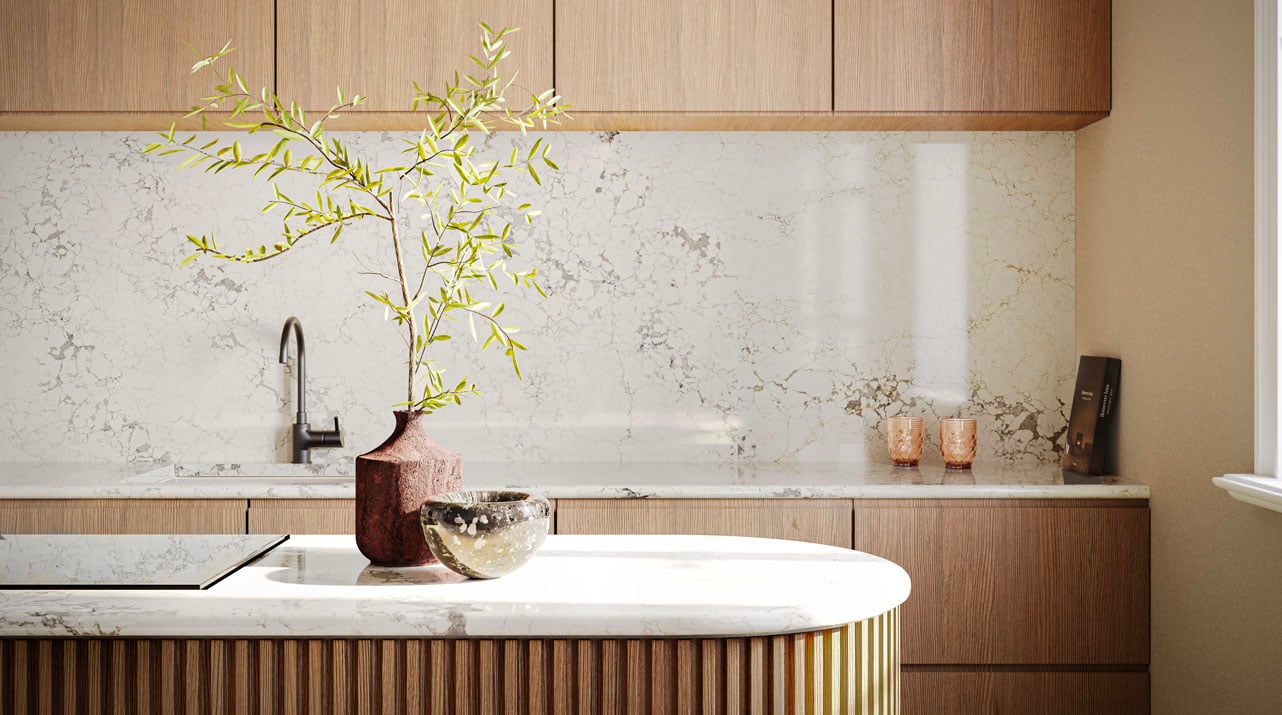 5105 Calacatta Dreamwave – ICON Worktop
Importantly, there is no price premium for ICON compared to our prior quartz products. Options range from our accessible Essentials group right up to our most coveted Group 5 Premium designs. We actively chose not to charge a premium for ICON because we believe offering safer, future-fit, and ethically crafted materials is simply the right and ethical way forward.
Caesarstone is leading the industry by actively transitioning its entire worktop portfolio to ICON technology. Products across all price groups in both our Essentials and Premium categories have already transitioned, ensuring maximum accessibility across all design styles and budgets without price inflation.
For off-plan homebuyers and renovators alike, choosing Caesarstone ICON delivers added value beyond traditional surfaces, providing future-proof confidence and long-term peace of mind without inflating your renovation budget. You can browse the colour catalogue to explore the full range.
Questions to ask before you accept a quote
Before signing off on any quotation for your kitchen, ask your fabricator or supplier these key questions:
- Does the quote include templating, fabrication, delivery, fitting, and VAT? (Make sure there aren’t any hidden extras).
- How many slabs are budgeted, and does the layout prioritise pattern continuity or slab yield?
- What brand of material is being supplied? (Make sure you’re receiving authentic, warrantied stone rather than low-grade, unbranded material, and check if it is certified and documented with a full Safety Data Sheet and Technical Performance Sheet).
- Are all sink, tap, hob, and socket cut-outs explicitly listed in the itemised estimate?
- What warranty is provided on both the material and the installation craftsmanship?
If you’re ever in doubt about a quote, notice massive price discrepancies between suppliers, or want clear guidance on your project setup, speak to us. You can explore our expert resources on design and specification, order samples to test in your light, or find a Caesarstone trusted partner to get an accurate, fully transparent quote tailored to your dream kitchen.

*May contain traces of less than 1% crystalline silica
.jpg)